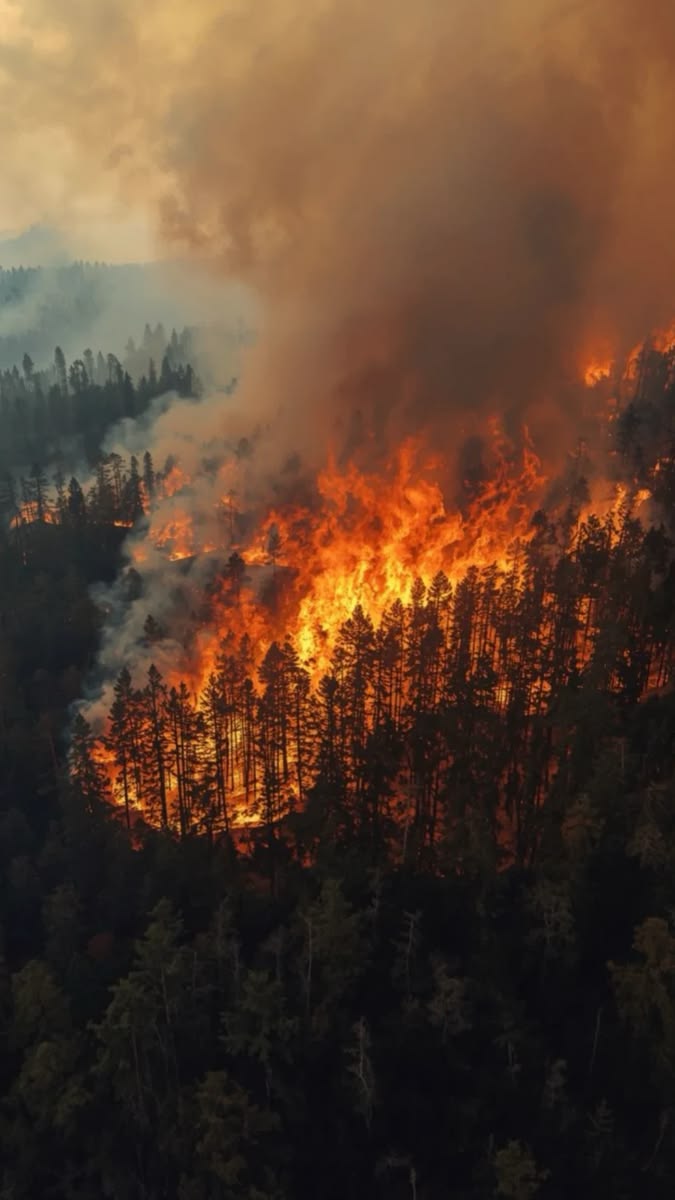
From the charred hills of California to the smoke-choked skies over Australia and the smoldering depths of the Amazon, forest fires are no longer seasonal disasters — they are a global alarm bell ringing louder with each passing year. Once considered isolated natural events, these infernos have grown in frequency, intensity, and scale, turning millions of acres to ash and displacing countless communities and wildlife. But behind the flames lies a far more unsettling truth: our warming planet is fueling the fire. In this post, we’ll explore how the surge in global wildfires is exposing the accelerating reality of climate change, what science tells us about the link between the two, and how much more devastating the future could become if we fail to act.
1. Introduction: A World on Fire
Every year, the images grow more familiar and more frightening. Skies turned orange over California and Australia, forests reduced to ash in the Amazon and Siberia, villages evacuated in Greece and Canada as flames race across landscapes that were once thought too wet or too remote to burn. What used to be called wildfire season has become a year-round reality, and no continent is untouched. From the boreal forests of the Arctic to the tropical rainforests of Southeast Asia, fires are burning hotter, spreading faster, and lasting longer than ever before.
This is no longer just a natural disaster. It is a symptom of a planet in distress. Rising global temperatures, prolonged droughts, and shifting weather patterns have created the perfect conditions for fire to thrive, turning forests that once acted as our greatest defense against climate change into vast sources of carbon emissions. As trees burn, they release decades worth of stored carbon in a matter of days, accelerating the very warming that made them vulnerable in the first place.
We are caught in a dangerous feedback loop, and the consequences extend far beyond the burn zone. Smoke travels thousands of miles, choking cities and damaging public health. Biodiversity is erased, livelihoods are destroyed, and the delicate balance of our ecosystems is pushed closer to collapse. The world is on fire, and the alarm it is sounding about the future of our climate can no longer be ignored.
2. The Recent Surge: Global Forest Fires by the Numbers
The numbers behind the recent wave of forest fires paint a stark and alarming picture. In 2023 alone, global tree cover loss due to fires reached record highs, with Canada experiencing its most destructive wildfire season ever recorded. More than 18 million hectares burned across the country, an area larger than many European nations, releasing an estimated two billion tonnes of carbon dioxide into the atmosphere, roughly triple Canada’s annual emissions from all other sources combined.
This was not an isolated event. From 2001 to 2023, the world lost an average of 5 to 7 million hectares of tree cover to fires each year, but the last five years have consistently exceeded that average. Data from NASA and the Global Forest Watch shows that fire-related forest loss increased by nearly 30 percent compared to the early 2000s. In 2021, extreme fires in Siberia scorched over 18 million hectares of boreal forest, while fires in the western United States have doubled in both size and intensity over the past two decades.
The trend is accelerating. The number of extreme wildfire events globally has increased by more than 20 percent since the early 2000s, and fire seasons are now on average two to three weeks longer than they were 40 years ago. What was once considered a seasonal threat confined to a few hotspots has become a year-round, global phenomenon, with unprecedented fires recently striking regions as diverse as Hawaii, Greece, and Chile.
3. Climate Change and Fire: Understanding the Connection
The link between climate change and forest fires is not just a correlation, it is a direct cause and effect relationship that is fundamentally altering how, where, and when fires burn. As global temperatures rise, the atmosphere becomes thirstier, drawing moisture out of soils, vegetation, and trees. This creates drier fuels that ignite more easily and burn with greater intensity. What was once damp, fire-resistant forest becomes a tinderbox waiting for a spark.
This warming effect is also extending fire seasons around the world. In many regions, spring arrives earlier and snowpack melts faster, while autumns stay warmer and drier for longer. This adds weeks or even months to the window in which wildfires can start and spread. At the same time, climate change is intensifying weather patterns that drive extreme fire behavior. Prolonged droughts parch landscapes, more frequent heatwaves bake forests to record dryness, and shifts in wind patterns can turn a manageable blaze into an uncontrollable firestorm in a matter of hours.
Perhaps most alarming is the feedback loop this creates. Forests are one of our most important natural carbon sinks, absorbing vast amounts of carbon dioxide. When they burn, that stored carbon is released back into the atmosphere in enormous quantities, further accelerating global warming. The loss of forest cover also reduces the planet’s future capacity to absorb emissions. In this way, forest fires are both a symptom of climate change and a powerful driver of it, creating a cycle where each fire makes the conditions for the next one even more dangerous.
4. Hotter, Drier, Longer: How Rising Temperatures Create Tinderbox Conditions
Hotter, drier, and longer fire seasons are no longer a prediction for the future — they are the reality on the ground. As global average temperatures continue to climb, they fundamentally change the conditions that allow forests to burn. Higher temperatures pull more moisture from the soil, from vegetation, and from the air itself, leaving trees, grasses, and leaf litter bone-dry and primed to ignite. What might have once taken weeks of drought to create a flammable landscape can now happen in a matter of days.
This drying effect is compounded by longer periods of extreme heat. Heatwaves are becoming more frequent, more intense, and more persistent, baking forests and turning them into tinderboxes. Snowpack is melting earlier in the spring, and rains are arriving later in the fall, which stretches the fire season at both ends. In many regions, the window when fires can start and spread has grown by weeks or even months compared to just a few decades ago.
The result is a dangerous feedback loop. Drier fuels burn hotter and faster, allowing fires to spread with terrifying speed and intensity. These megafires generate their own weather systems, creating lightning and high winds that spark and spread new blazes. And as more forest burns, more carbon is released into the atmosphere, driving temperatures even higher and setting the stage for the next fire to be even worse.
5. Case Studies: From California to Australia to the Amazon
The abstract threat of climate change becomes terrifyingly concrete when we look at the recent history of megafires around the world. In California, fire season is no longer a season at all. Fueled by prolonged drought, record-breaking heat, and decades of fire suppression that left forests choked with dry fuel, fires like the 2018 Camp Fire and the 2020 August Complex have rewritten the record books. The Camp Fire alone leveled the town of Paradise in hours, killed 85 people, and showed how quickly wildland fires can become urban disasters, while smoke from subsequent fires turned skies orange over San Francisco and blanketed much of the western United States for weeks, creating a public health crisis far from the flames themselves.
On the other side of the world, Australia’s Black Summer of 2019-2020 offered an even more harrowing preview. Following three years of drought and the hottest and driest year on record, more than 46 million acres burned across the continent. The fires were so intense they generated their own pyrocumulonimbus thunderstorms, launching embers miles ahead of the fire front and sending a plume of smoke that circled the entire Southern Hemisphere. Nearly three billion animals were killed or displaced, thousands of homes were destroyed, and scientists estimated the fires released around 900 million tons of carbon dioxide, nearly double Australia’s annual greenhouse gas emissions, creating a brutal feedback loop where climate change fuels fires that in turn accelerate climate change.
In the Amazon, the story is different but deeply connected. Here, fire is not a natural part of the ecosystem. The lush rainforest does not burn on its own; it is intentionally set ablaze to clear land for cattle ranching and agriculture after deforestation. In 2019, satellite images showing the rainforest burning at an unprecedented rate shocked the world, with more than 80,000 fires detected in a single year. Climate change makes this destruction even more dangerous, as rising temperatures and altered rainfall patterns dry out the forest, making it more flammable and less resilient. Scientists warn that if deforestation and warming continue, large parts of the Amazon could reach a tipping point, transforming from a vital carbon sink that absorbs emissions into a dry, fire-prone savanna that releases them.
6. The Feedback Loop: How Forest Fires Accelerate Climate Change
Forest fires are not just a symptom of climate change, they are a powerful driver of it, creating a dangerous feedback loop that feeds on itself. Forests act as one of the planet’s most vital carbon sinks, absorbing billions of tons of carbon dioxide from the atmosphere every year and storing it in trunks, branches, roots, and soil. When a forest burns, all of that stored carbon is released back into the atmosphere in a matter of hours or days. A single severe fire season, like those seen recently in Canada, Siberia, and Australia, can emit more CO2 than entire industrialized nations do in a year, instantly undoing decades of carbon sequestration.
That massive pulse of greenhouse gases then traps more heat, raising global temperatures further. Warmer temperatures, in turn, create the exact conditions that make future fires more likely and more intense. They dry out vegetation and soil, turning forests into tinderboxes, they extend fire seasons by weeks or even months, and they increase the frequency of lightning strikes and droughts that ignite and sustain blazes. The result is a vicious cycle: more warming leads to more fires, and more fires lead to more warming.
The loop does not stop with carbon alone. Fires also destroy the very system that could help break the cycle. A burned forest can take decades, even centuries, to regrow to its former capacity as a carbon sink, and in many cases it never does. Severely burned landscapes may transition into shrubland or grassland, which stores far less carbon. Fires in boreal regions and the Arctic are particularly alarming, as they thaw permafrost and release ancient stores of methane, a greenhouse gas more than 80 times more potent than CO2 in the short term. Dark soot and char left behind also reduce the Earth’s reflectivity, causing the land to absorb more solar heat instead of reflecting it.
In essence, every major fire makes the next one more probable and the climate crisis harder to reverse. Without breaking this feedback loop by aggressively reducing emissions and investing in forest resilience and restoration, we risk pushing the system past a tipping point where fires and warming accelerate beyond our ability to control them.
7. Beyond the Flames: The Hidden Costs to Health, Wildlife, and Economies
While images of burning forests dominate the headlines, the most devastating impacts of wildfires often unfold long after the flames are extinguished. The smoke alone carries a severe public health burden, releasing fine particulate matter and toxic gases that can travel thousands of miles. Exposure is linked to respiratory illness, heart complications, aggravated asthma, and long-term risks, placing immense strain on healthcare systems and disproportionately affecting children, the elderly, and outdoor workers.
Wildlife faces an equally silent crisis. Beyond the immediate loss of life, fires destroy habitats, fragment ecosystems, and wipe out food sources that take decades to regenerate. Species already threatened by habitat loss are pushed closer to extinction, while aquatic ecosystems suffer as ash and debris choke rivers and streams, depleting oxygen and poisoning water supplies.
The economic toll is staggering and far-reaching. Direct costs include firefighting efforts, property destruction, and infrastructure damage, but indirect losses run even deeper. Agriculture suffers from scorched land and contaminated soil, tourism collapses in fire-scarred regions, supply chains are disrupted, and insurance premiums skyrocket. For many communities, especially those dependent on forests for livelihoods, a single fire season can erase years of economic progress, revealing that the true price of forest fires is measured not just in acres burned, but in lives, livelihoods, and ecosystems disrupted.
8. Who Is Most at Risk? Vulnerable Communities on the Front Lines
While wildfires do not discriminate in what they burn, their impact is far from equal. The burden falls heaviest on communities that are already the most vulnerable, turning a natural disaster into a crisis of environmental justice.
Indigenous communities are often on the immediate front lines. Many live in and steward forested regions that are now hotspots for extreme fire activity, from the Amazon Basin to the boreal forests of Canada and Australia. Not only are their homes and livelihoods directly threatened, but their cultural heritage, sacred sites, and traditional food systems are at risk of being erased by fire.
Low-income and rural communities face a different but equally severe set of risks. They are more likely to live in the wildland-urban interface where housing is more affordable but fire danger is highest. They often lack the resources to fire-harden their homes, clear defensible space, or afford adequate insurance. When evacuation orders come, they may not have reliable transportation or a safe place to go, and recovery is slower and more difficult without a financial safety net.
Health vulnerability also determines who suffers most. Children, the elderly, pregnant people, and those with pre-existing respiratory or cardiovascular conditions are disproportionately harmed by prolonged smoke exposure. For farmworkers, construction laborers, and others who work outdoors, avoiding hazardous air is not an option, forcing them to choose between their health and their income. In urban areas far from the flames, low-income neighborhoods with poor housing quality and lack of air filtration face higher indoor smoke infiltration.
Globally, the inequity is even starker. Communities in the Global South often have fewer early warning systems, fewer firefighting resources, and less government support for disaster response and rebuilding. As climate change intensifies the fire season, these frontline communities will continue to experience the first and worst consequences, despite having contributed the least to the emissions driving the crisis.
9. What Science Predicts: How Much Worse Could It Get?
The science is clear on one point: what we are seeing now is not the peak, but the beginning. Climate models consistently show that as global temperatures continue to rise, the conditions that create catastrophic forest fires will only intensify. A warmer atmosphere acts like a giant sponge, pulling more moisture out of soil and vegetation and turning forests into tinderboxes. For every additional degree of warming, scientists estimate that the area burned by wildfires could increase exponentially.
Projections from the Intergovernmental Panel on Climate Change paint a sobering picture. Even if the world meets its most optimistic emissions targets and limits warming to 1.5 degrees Celsius, fire weather seasons will grow longer and more severe across every continent. If warming reaches 2 degrees or beyond, which current policies make increasingly likely, many regions that were once considered low-risk will face extreme fire danger for months at a time. Areas like the boreal forests of Canada and Siberia, which store vast amounts of carbon, are expected to see some of the largest increases in fire activity, creating a dangerous feedback loop where fires release more carbon, which in turn drives more warming.
It is not just about more fires, but about more intense and uncontrollable ones. Researchers predict a sharp rise in the frequency of what they call fire-generated thunderstorms, or pyrocumulonimbus clouds, where the heat from a megafire creates its own weather system, generating lightning that can spark new fires miles away. Combined with more frequent droughts, stronger winds, and earlier snowmelts, future fires will be faster, hotter, and harder for firefighters to contain. Without dramatic cuts to greenhouse gas emissions, scientists warn that the record-breaking fire seasons of today will become the average summers of tomorrow.
10. From Crisis to Action: Global Strategies for Prevention and Mitigation
While the scale of modern wildfires can feel overwhelming, the shift from crisis response to proactive action is already underway, driven by a combination of science, policy, and community engagement. Global strategies for prevention and mitigation now focus on addressing both the immediate triggers of fire and the underlying driver of climate change. On the prevention front, this means investing in smarter land management, including prescribed burns that clear excess fuel, restoring degraded forests to increase resilience, and enforcing stricter regulations on land-use and agricultural burning. Early warning systems powered by satellite monitoring, AI-driven risk mapping, and improved weather forecasting are allowing governments to detect and respond to fires before they spiral out of control.
Mitigation, however, requires a broader commitment to slowing climate change itself. Reducing greenhouse gas emissions remains the most critical long-term strategy, as hotter temperatures, prolonged droughts, and erratic weather patterns are directly extending fire seasons and intensifying fire behavior. International cooperation through climate agreements, alongside national investments in renewable energy and carbon sequestration projects like reforestation, are essential to breaking this cycle. Equally important is building fire-adapted communities through better building codes, defensible space planning, and public education campaigns that teach residents how to prepare for and respond to fire risk.
Ultimately, moving from ashes to action means recognizing that forest fires are not just a natural disaster to be contained, but a climate alarm that demands a coordinated global response. Prevention and mitigation are no longer separate efforts but two sides of the same strategy for a more resilient future.
11. What You Can Do: Individual and Community Solutions
11. What You Can Do: Individual and Community Solutions
It is easy to feel powerless watching forests burn on the other side of the world, but the response to the wildfire crisis does not rest solely with governments and international panels. Meaningful change starts at the individual and community level, where collective action can significantly reduce risk and build resilience. On a personal level, this means making conscious choices that lower your carbon footprint, from reducing energy consumption and supporting sustainable products to considering how you travel and what you eat, as all of these actions help address the root cause of hotter, drier conditions. It also means being fire-wise, especially if you live near wildland areas, by creating defensible space around your home, using fire-resistant building materials, and strictly following local burn bans and fire restrictions.
At the community level, impact multiplies. Joining or organizing local initiatives such as neighborhood preparedness programs, community wildfire protection planning, and volunteer restoration projects helps towns become more adaptable to fire. Supporting and advocating for local policies that promote responsible forest management, controlled burns, and sustainable land use can protect ecosystems before a spark ever starts. Educating others, donating to reputable reforestation and disaster relief organizations, and participating in citizen science projects that monitor forest health are also powerful ways to turn alarm into action. When individuals and communities act together, they not only help prevent the next fire from starting but also ensure that when fires do occur, people and landscapes are better equipped to recover.
12. Conclusion: Turning Alarm into Action Before It’s Too Late
The smoke from today’s forest fires does more than darken the sky, it reveals a clear warning about the future we are creating. From the record-breaking wildfires in Canada and Australia to the unprecedented blazes sweeping through the Mediterranean and the Amazon, the pattern is undeniable: a warming planet is making our forests hotter, drier, and far more flammable than ever before. These fires are not isolated natural disasters but symptoms of a deeper climate crisis, one that feeds on itself as burning forests release stored carbon, destroy vital carbon sinks, and accelerate global warming even further.
If current trends continue, scientists warn that what feels like an extreme fire season today will become the average season of tomorrow, with longer fire windows, more intense infernos, and greater threats to human health, biodiversity, and economies. Yet this future is not inevitable. Turning alarm into action means moving beyond simply fighting fires to addressing their root cause. That requires rapid cuts in greenhouse gas emissions, smarter forest management, investment in early warning and resilience systems, and a global commitment to protect and restore the ecosystems that protect us.
The ashes left behind are a reminder of what we stand to lose, but also of the narrow window we still have to act. The choice between a world of escalating flames and one where forests thrive again is still ours to make, but only if we act before the alarm fades into irreversible loss.
From the smoldering forests of California to the vast burns of Australia and the Amazon, the message is clear: these unprecedented fires are not isolated tragedies but urgent alarms of a planet in crisis. As we’ve seen, the link between rising global temperatures, prolonged droughts, and increasingly ferocious fire seasons is undeniable, and without decisive action, the future promises even longer, hotter, and more destructive infernos. Yet understanding this threat is the first step toward change. By supporting sustainable policies, reducing our carbon footprint, and demanding accountability, we can still alter the trajectory and protect both our forests and our future before the ashes become all that remains.
——————————


Leave a Reply